
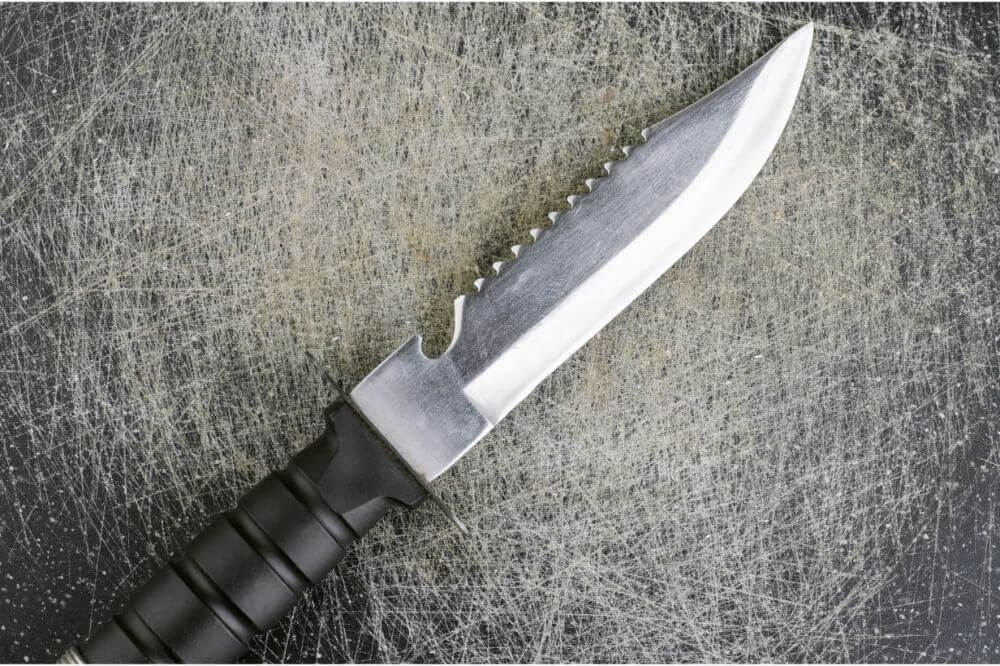
If you plan to buy a survival knife, one of the most important things you need to know is what the knife is made of, specifically the blade. Here we are talking about metal and, more specifically, steel. Obviously, we aren’t talking about carbon fiber or HD plastic blades, because let’s face it, they just aren’t that good. If you are going to buy a survival knife, you need a good piece of steel. That said, there are different types of steel that survival knives can be made of, and they’re not all the same. So first, we’ll look at the best steel for a survival knife.
The Most Popular Types of Steel for Survival Knives
There are several types of steel commonly used for survival knives. First, we’ll look at the most popular types to choose from.
440A Stainless Steel
If you’re looking for an affordable survival knife, a 440A stainless steel blade is the way to go. Now, this is not to say that 448 stainless steel isn’t a good type of steel.
The reason why it is so affordable is just that it is extremely common and readily available due to the laws of supply and demand.
This type of steel is also easy to sharpen and relatively resistant to corrosion. However, it’s not the best type of steel to use compared to others. If you need a serious survival knife that can handle a lot of punishment, this is not the way to go.
1095 High Carbon Steel
This is perhaps the most commonly used type of steel when it comes to survival knives. The main benefit of 1095 high carbon steel is that it is extremely tough and durable. Knives made out of this material can take a beating without chipping, cracking, or bending.
However, 1095 high carbon steel is not overly resistant to corrosion, so you need to keep this steel dry, which can be a problem for survival purposes. For this reason, most knives made out of 1095 high carbon steel will also feature a coating for corrosion resistance.
One advantage of 1095 high carbon steel is that it can start a fire the same way you would with a flint steel striker kit because of the high carbon alloy. So yes, when it comes to survival situations, being able to make a fire can be vital.

D2 Steel
This is another high carbon steel, similar to the material we spoke of above. D2 steel is more corrosion resistant than 1095 high carbon steel but less dense and far less durable. You can’t beat up a D2 blade the same way you would a 1095 blade.
AUS-8 Stainless Steel
This is a type of steel from Japan with chromium content. For this reason, AUS-8 steel is resistant to rusting and corrosion. In addition, it results in extremely sharp and hard blades that can take a beating. These blades are hard, and they aren’t easily damaged. These knives are some of the best, but they are tough to sharpen due to the steel’s high density.
The No. 1 Survival Knife Steel
All types of steel we have looked at are perfectly fine. However, they don’t come close to the best kind of steel for survival knives – 154CM steel. Let’s see why this is the case.
The only real downside with this type of steel is that it is tough to forge and work with; this makes it expensive to purchase.
That said, in terms of corrosion resistance, density, edge retention, durability, and taking a beating, you won’t find anything better. It’s also easy to sharpen. For all of these reasons, 154CM steel has become the most popular high-end steel for survival knives.
Conclusion
Now you know the basics of survival knife steel. Understanding the different types and their properties, you can make an informed decision on your blade.